Backwards and Forwards

One of the things I love about the academic year is that we get the opportunity to pause and restart after each break however I am always aware that there is the potential for this to cause a fragmentation in approach. A temptation to start anew, repeatedly. Instead, keeping a focus on what has gone before and using it as a constant reference to where we are heading next is key to success. A strategy that forms a continuum rather than a series of disparate approaches. I start the year by sharing a clear focus and set of strategies to achieve our desired outcomes but ensure they are tightly linked to what has gone before. 

This line of thinking is something that has been refined during my last year in post; I have spent a lot of time learning how to separate the strategic leadership of the department from the operational. It has been something of a learning curve but has also proved to be an exciting pivot point in my development as a leader. 

Based upon my improved understanding of long-term planning and the outcomes of our work as a department last academic year, I have determined what changes need to be made to further improve the outcomes and experience of our pupils. The goals I will be working towards are focussed on homework and feedback. These are areas where we can be more productive in terms of how staff time is used and more efficient in how feedback is moving pupils progress forwards. Homework is also an area that could be used with greater precision and cohesion. These goals impact upon all year groups thereby removing the tendency to focus only on exam groups at the expense of other year groups. This will differ in your departments so what I intend to share with you is the working process I use to achieve my aims. 

From September, each term will focus on two specific goals. To ensure that we stay on track and that the goals are achieved, the overall strategy will be broken down into a sequence of small, achievable and measurable stages as this has proved to be a highly effective way of moving forwards in order to monitor progress. Each week, for each goal, I will set out what I intend to achieve and break this down further to a set of daily actions. At the end of each day progress is reviewed and the plan amended for the next day. A weekly review then takes a wider look at what has been achieved and informs planning for the following week. This backwards/forwards process is one I used this year as part of a leadership project to improve our productivity in terms of achieving what we set out to do in a designated time frame. I found the process to be both successful on a professional level but also very rewarding on a personal one. The process enables you to see the small, everyday ‘wins’ made. We are often too tied up in the business of the school day to really slow down and see where we have achieved success. Taking a more microscopic view of our work than a macro overview allows us to be much more critical of where our work is actually having the impact we intend.

As department leaders, we all have goals we will be working towards and results we will be required to account for. If the monitoring process is a weekly and daily activity then issues can be addressed promptly. Looking back at what has been achieved is critical to moving forward if we are to stay on track and achieve what we set out to do. Any plan is only as good as its execution. Let’s ensure the year ends with the same optimism that it starts.




A Never-Ending Story

Improving Teaching and Learning – Cheryl Quine @MissSequin
The new term is well underway for all of us and with it comes the next cycle of plans and goals to improve pupil outcomes through adapting our practice in regard to teaching and learning. I’m sure all of us know that this is a never-ending cycle, the impact of which may result in marginal gains, significant leaps forward or no discernible difference at all. The latter is obviously an outcome to be avoided. Our time is so limited that every action needs to be one that moves learning forward, in one way or another.
Over the last six years in role I have made a wide variety of changes, shifting the department from one driven by ideology to evidence-informed practice. With it, we have seen a five-year upward trend in results but there is still so much more that can be done.
When reflecting on last year’s results, I believe involving our students in the learning process, making them intensely aware of how they learn, was a key factor behind their achievements. As teachers, we very much embraced the Learning Scientists’ ‘six strategies for successful pupils’ in both class and homework. What pushed this further was our constant dialogue about this with the pupils. We helped them understand how they were learning, what worked, what didn’t and the buzz amongst them from this sense of empowerment was infectious. Pupils were talking about ‘retrieval practice’ and the ‘forgetting curve’ on the corridors and with senior staff during lesson drop-ins. Their understanding of how to learn gave them the tools to make really effective decisions about how to prepare for their exams.
Alone, this was not enough. Knowing what worked didn’t mean all pupils would apply it outside of school. To address this, I considered what factors I had that could be controlled by the department in terms of revision. Whilst the pupils had plenty of resources, revision books, practice questions, online support materials, they weren’t necessarily using them to best effect or even at all, for some. I decided that homework was the one factor outside of school that I could control and so devised a scaffold around retrieval, concrete examples, dual coding, elaboration, interleaving and spaced practice. It ensured that all pupils followed a revision programme, built around proven learning strategies, that covered, plus revisited, material from January through to the exams. Non-completion wasn’t an option and this was monitored closely so all work would be completed. Analysis of the final data showed that only 0.7% of this work was not finished during this time. A staggering statistic as it meant that pupils who would not have revised independently had instead spent an extended time period, outside of the classroom, building their knowledge and retention in preparation for the exams. Pupil voice surveys talked of the ‘confidence’ the scaffold had built in their self-belief that they were well prepared for their forthcoming exams.
This approach, whilst effective, was still very much a ‘final fix’ when it came to ensuring our pupils were exam ready. So, our focus has now shifted very much onto year 6 into 7. We spent last year building relationships with ten of our largest feeder primary schools and are now taking that work forward into year 7 who are following a mastery curriculum. The principles of direct instruction, economy and consistency of our language, clarity of our visual materials and continued use of retrieval are very much at the heart of what we are doing.
One of our goals this year is to use whole class feedback to identify and address gaps in learning. To move distinctly away from ‘correcting’ work and instead solely on addressing learning gaps. Reteaching and allowing the opportunity for practise in order to develop pupil understanding. My whole department are undertaking this across all key stages and a team of five of us are using it as our research-based PPD enquiry question which will then feedback into the practice of the wider department.
This will be supported by our bespoke exercise books in KS3, plus pushing forward our work to get pupils to talk ‘like an essay’, teaching ‘literature’ over ‘texts’, improving note-taking and organisation through use of Cornell notes, an open door drop-in policy, use of core terminology and resources, MCQ, reading whole texts uninterrupted by study, the Thinking Reading programme, engaging parents through information evenings… We are constantly trying to improve our practice and the educational experience for our pupils whilst ensuring they develop a love of our subject. The word count I have here only allows me to hint at a fraction of what we are doing but I am more than happy to chat with anyone who wants to know (or see) more.

Team Spirit

My second blog, again, shamelessly alludes to hits of the ’90s to encapsulate the theme. Should schools be structured into departments or teams?

My preference is to opt for the latter but this is more complex than simply changing the label.

So, as it’s that ‘quiet’ time of year (when staff are desperately trying to pack in all the work that has been shoved to the sidelines as the terms have passed) my department is using some of this time to halt the Merry-Go-Round. We need to step off the whirl of the academic year and step out to gain clarity. To focus the discussion, I have created a list of thinking points that centre around key issues that challenge and get to the heart of both the big questions and also the smaller ones. The discussion around whether pupils should indent or leave a line to demarcate paragraphs was a surprisingly thorny one… At this point you may be raising an eyebrow but can you honestly say that all your team are on the same page, in every detail? And if not, why aren’t they? Maybe your department does collectively all work as one, religiously putting in place all agreed policy… but can they articulate why? Are all your routines and systems thought through? Do they have a defined rationale? Or are you doing things a certain way because that’s the way it’s always been done? The need to challenge every aspect of our practice is mandatory to develop a team that truly understands the narrative that underpins the curriculum. A team that speaks with one voice is a powerful one.

Irrespective of Ofsted’s latest changes, the intention to unite my department’s focus has been bubbling away on the back-burner for a while and, finally, gained time has allowed the space to start getting to the heart of the debate because if we are to be confident that students are experiencing the best we have to offer we need to ensure equality in our approach. From the ‘what’ to the ‘why’ to the ‘how’, we should be able to articulate every aspect of the experience students have as they progress through our departments. Whilst my subject is English, this issue has much wider parameters: subjects, key phases- primary, secondary, and all the layers of staffing that make up our schools, we all need to start making time to talk. We are working in exciting times where an active dialogue about education is buzzing across social media and crossing back over into the workplace. To coin the vocabulary of my subject, we have reached a volta and need to seize the opportunity to open up purposeful conversations.

A mission statement, a manifesto, a statement of intent… I have yet to ‘brand’ the proposed outcome of our discussions. The intention though is simple, in theory. As a department, my aim is to get us to define who we are. It should be straightforward but in a large team, with staff spanning a wide range of age and experience, views about teaching vary, widely. You’d think that we’d all hold similar principles about the purpose of education but we don’t, yet.

Teaching can be a very solitary profession, shut away in a classroom, separated from colleagues for the majority of the day, marking and planning taking up the hours after the school day has ended. Making time to gather together and determine exactly what you are trying to achieve is indescribably important. An obvious statement, but without heartfelt, lengthy discussion how can we ever really be a ‘team’? Without that ‘team’ ethos, departments function as a disparate collection of individuals. Staff deliver the curriculum without a clear sense of the core values and knowledge to be imparted. As a result, students over the key stages experience an incoherent narrative. No matter how tight the curriculum narrative may be, if staff don’t collectively know how to tell the story it all falls apart.

This team of story weavers extends across key stages. At the same time as my team are defining our department rationale, we are also working closely with ten of our feeder primary schools. The project aims to develop a working dialogue between the key phases. It allows us time to observe and engage with each other’s practice and to work on ways to stitch together the gap as our students move from KS2 to 3. It has been fascinating and exhilarating to observe primary colleagues and teach their classes. The process of producing a crossover lesson that utilised prior learning but bridged the gap with suitable levels of challenge has been a stimulating opportunity. But that is just the start of building our cross-phase team, only yesterday all my department and five of our feeder primaries came together to work with the RSC for the day to unite in our approach to teaching Shakespeare’s tales.

By fully understanding every aspect of our approach, we can also plot out our own story, take ownership of our shared narrative, a coherent and considered curriculum then opens up for our students. As they move from teacher to teacher, across years and key stages, the narrative continues, develops, grows; learning is logical, meaningful, progressive. We are the narrators of this education story and we must be mindful as to how we want the story to be told.

Moving On Up

Any questions? Interviews often close with this seemingly easy query and this is usually the point I go into a tail spin. Not this time though. I’d just spent a full day outlining, elaborating, justifying my vision as to what the role of Director of English meant to me so, emboldened, (or delirious with exhaustion) decided to get #10%braver and bounced the question back to the panel. What did the role mean to them?

Most of the replies echoed my interpretation but the phrase that really struck home was how the post involved ‘moving up and out’, in (almost) the words of the inimitable Heather Small. The moving ‘up’ part was clear; the role carried with it leadership team responsibilities but it was the ‘out’ that really excited me; the potential to make a difference on a wider scale. After all, the opportunity to make a difference is why most of us are drawn to teaching in the first place. In fact, is that not what unites most of edutwitter? A desire to get to the heart of what matters. To keep moving forwards. To effect change, tweet by tweet.

For context, I was already Head of English and this was an appointment within my own school. I’d been in post six years and was happy with the progress made. So much had been achieved but yet I was frustrated as there was so much more I wanted to do. I sometimes felt like I was stuck on repeat. I could see ways that simple changes could be made and that those marginal gains had the potential for significant impact overall. The move ‘up’ means I can start to make those changes. It is this excitement about changing the system from within that has led me to start a blog.

The ability to reflect is empowering and writing a blog will allow me the space and time I need to question myself, to qualify my content before I press ‘publish’, to question if I have opted to learn the key lessons from my actions and mistakes. I hope those who wish to join me on my journey view themselves as critical friends. We are all working towards the same goal and I feel sharing my experiences may be of use to those starting out in new HoD, or similar, roles.

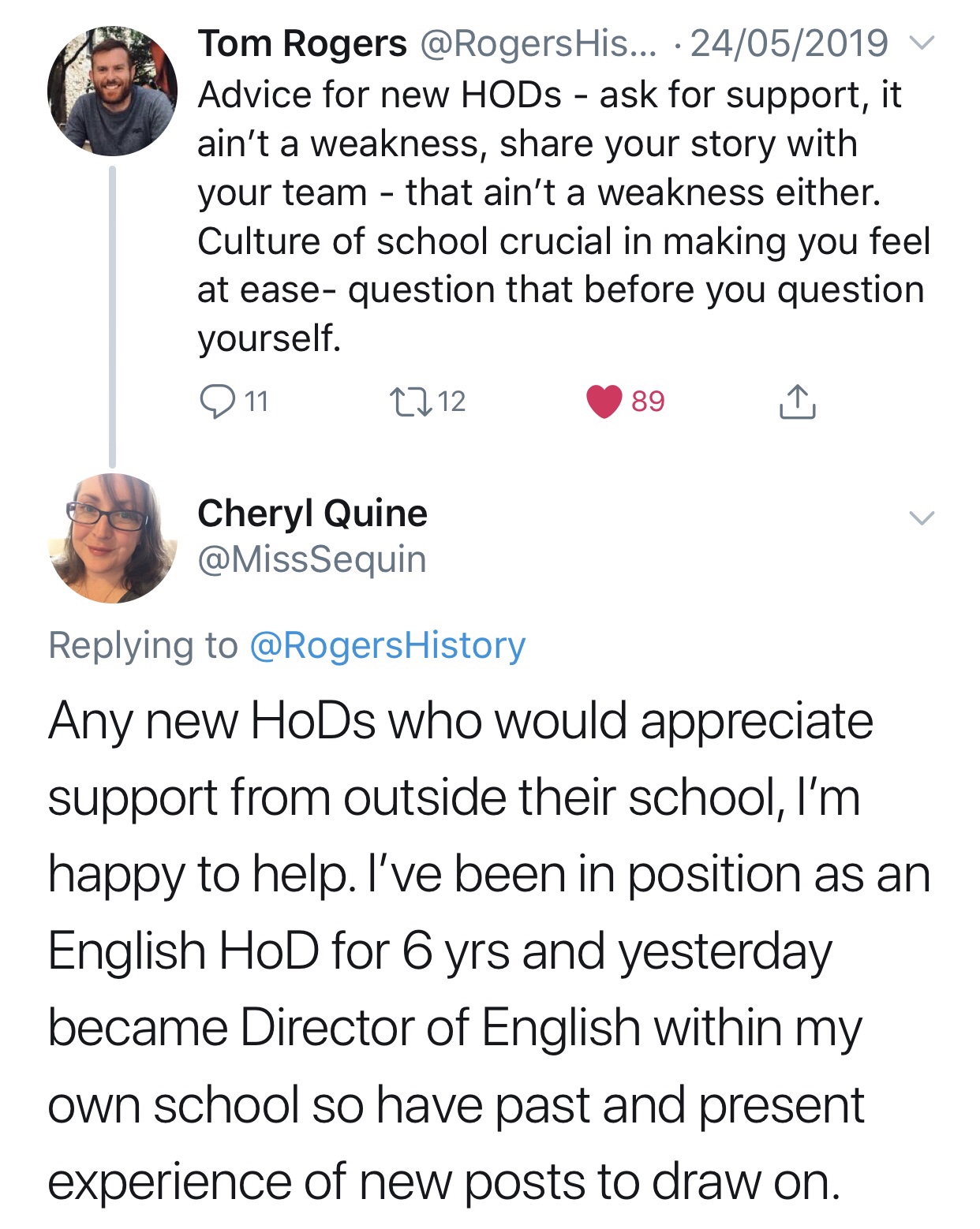
Tom Rogers tweeted about this recently. This has also partly been the inspiration for writing this post. I offered to be a sounding board for others starting out in new roles of responsibility and the responses I received made me realise there is a place, a need even, for a voice focussing on stepping up. I know I certainly won’t always have the answers. I’m not setting myself up as an expert, just a fellow teacher who is finding their way through the next layer of responsibility. If others can glean something useful from my highs and lows, fantastic!

Whilst the shift in roles from department lead to Director may be subtle it opens the doors to opportunity. It involves whole school responsibility wider than my subject and the opportunity to voice opinions as part of the extended senior team. To quote Heather, ‘I’m moving on up, moving on out, nothing can stop me’.

P.S. But if I forget myself and I go all Ozymandias, please step in and intervene. 💕